Home > YA nonfiction > The Story of Britain
The Story of Britain
Posted on Monday, May 9, 2011 by android apps market for tablests
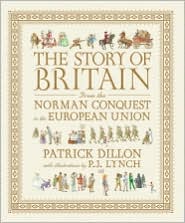
The Story of Britain From the Norman Conquest to the European Union by Patrick Dillon. 2011. Candlewick Press. 352 pages.
From the introduction: Long ago, on the eastern edge of the Atlantic Ocean, there were two islands.
The title for this one says it all. The introduction takes readers from 55 BC to 1066 AD. And the remaining chapters cover the years 1066 to 1999. There are six sections: "The Middle Ages," "The Tudors," "The Stuarts," "The Georgians," "The Victorians," and "The Twentieth Century." So what kinds of things get covered in the entries? Well. Kings. Queens. Parliaments. Wars. Revolutions. Invasions. Religious Conflicts. Politics. Economics. Social class divisions. Scientists and inventors. Explorers and empire-builders. A few influential authors. A little bit of everything really. It isn't just about the monarchy. It isn't just about the wars Britain has taken part in through the centuries. Though both of those take up a significant place in the book. The book also tries to cover Scotland and Ireland and Wales.
The Story of Britain is concise and creative. Within the entries themselves, readers will find it almost impossible to find a date. (I'm guessing that the author did NOT want to be like a text book and use dates to bridge together sentences like "And then this happened. And then this happened. And then this happened.) The dates are instead found within the timeline at the end of each section. The text itself is casual and conversational. And you might say creative. He gives voice to a variety of people in society--groups of people and individuals--by using dialogue. (Most entries have quotation marks--but many of these quotation marks are not quoting a *real* source. Though of course some are. The quotation marks that rely on primary sources or reference materials use italics so readers know what's what.) I'm not sure how I feel about this really. On the one hand, I think it keeps the book light and conversational. But on the other hand, I like to keep fiction and nonfiction separate from one another. And the narrator of this one definitely is not as objective as he could be--as he should be perhaps? I could definitely see some of his statements as having an agenda. For better or worse. I mean when you write with a message, with an agenda, with a slant--readers will either already agree with you because they share your views OR not agree with you because they don't share your viewpoint on that particular issue. While I suppose any history book--any text book--could be seen as having bias, of not really being as objective as it could be, I found this one noticeably so.
Did I like it? In places. I found it informative and reader-friendly. There were gaps in my education--and my education for British history basically came from my literature courses and my love for historical fiction--and this book helped me connect the dots. I don't think I loved it. Not as much as I was hoping. But. It was still an entertaining read.
© 2011 Becky Laney of Becky's Book Reviews
From the introduction: Long ago, on the eastern edge of the Atlantic Ocean, there were two islands.
The title for this one says it all. The introduction takes readers from 55 BC to 1066 AD. And the remaining chapters cover the years 1066 to 1999. There are six sections: "The Middle Ages," "The Tudors," "The Stuarts," "The Georgians," "The Victorians," and "The Twentieth Century." So what kinds of things get covered in the entries? Well. Kings. Queens. Parliaments. Wars. Revolutions. Invasions. Religious Conflicts. Politics. Economics. Social class divisions. Scientists and inventors. Explorers and empire-builders. A few influential authors. A little bit of everything really. It isn't just about the monarchy. It isn't just about the wars Britain has taken part in through the centuries. Though both of those take up a significant place in the book. The book also tries to cover Scotland and Ireland and Wales.
The Story of Britain is concise and creative. Within the entries themselves, readers will find it almost impossible to find a date. (I'm guessing that the author did NOT want to be like a text book and use dates to bridge together sentences like "And then this happened. And then this happened. And then this happened.) The dates are instead found within the timeline at the end of each section. The text itself is casual and conversational. And you might say creative. He gives voice to a variety of people in society--groups of people and individuals--by using dialogue. (Most entries have quotation marks--but many of these quotation marks are not quoting a *real* source. Though of course some are. The quotation marks that rely on primary sources or reference materials use italics so readers know what's what.) I'm not sure how I feel about this really. On the one hand, I think it keeps the book light and conversational. But on the other hand, I like to keep fiction and nonfiction separate from one another. And the narrator of this one definitely is not as objective as he could be--as he should be perhaps? I could definitely see some of his statements as having an agenda. For better or worse. I mean when you write with a message, with an agenda, with a slant--readers will either already agree with you because they share your views OR not agree with you because they don't share your viewpoint on that particular issue. While I suppose any history book--any text book--could be seen as having bias, of not really being as objective as it could be, I found this one noticeably so.
Did I like it? In places. I found it informative and reader-friendly. There were gaps in my education--and my education for British history basically came from my literature courses and my love for historical fiction--and this book helped me connect the dots. I don't think I loved it. Not as much as I was hoping. But. It was still an entertaining read.
© 2011 Becky Laney of Becky's Book Reviews
Category Article 2011, Candlewick, Nonfiction, review copy, YA nonfiction
Powered by Blogger.
Blog Archive
-
▼
2011
(4034)
-
▼
May
(56)
- May Reflections
- The Penelopiad
- The Sunday Salon: Week in Review #22
- June Reading List
- Library Loot: Fourth Trip in May
- The Last Chronicle of Barset
- The Miles Between (YA)
- Peony
- A House Divided
- The Virginian
- Some Buried Caesar
- What Happened To Goodbye (YA)
- The Sunday Salon: Week in Review #21
- Library Loot: Third Trip in May
- Meme: A Book Lover's Survey
- Blogger Fixed Length Date Format
- Bumped (YA/Adult) (Some spoilers)
- The Throne of Fire (MG)
- Dueling Authors: Jane Austen vs. Charles Dickens
- The Silent Speaker
- Sunday Salon: Week in Review #20
- Library Loot: Second Trip in May
- Blogger Post Title Changes Color on Post Page
- Kinfolk
- Sons
- Black Orchids
- Track the Time You Spend onEach Website with Chrom...
- [Tablet] Acer ICONIA TabA500 to be priced Rs 27,99...
- 20 Bookmarklets asAlternative to PopularExtensions...
- Gmail Enables Storing upto25,000 Contacts! [3 GBSt...
- [Alert] LastPass Security Compromised! Users Advis...
- 3D Globe shows GoogleSearch Volumes byLanguage!
- Download Twitter BasedInstant Messenger for YourDe...
- Customize Your Google Reader Layout with Reader Plus
- Get Rid of Autorun Virus withUSB Immunizer
- [Online Tip] Send yourself anEmail in the future!
- [Internet Censorship] MozillaQuestions US Departme...
- Windows 7 and Windows VistaGadgets
- Google Makes Searching forImages Easy with Sort by...
- Microsoft to Buy Skype for$8.5 Billion
- The Good Earth
- Google I/O: countdown to the keynote kickoff
- Share and personalize your Google Goggles experien...
- The Story of Britain
- Sunday Salon: Week in Review #19
- Happy Mother's Day!
- One book, two book, three book, four...
- Library Loot: First Trip in May
- Google Earth optimized for Android-powered tablets
- East Wind: West Wind
- Stay (YA)
- Google Voice and Sprint integration is live
- City of Fallen Angels (YA)
- Sunday Salon: Week In Review #18
-
▼
May
(56)